Magnetite deposit on graphene nanoplatelets Surface: An assessment of grafting parameters
Author: Faiz Ahmad - July 2023
Saba Ayub, Beh Hoe Guan, Hassan Soleimani, Zaib Un Nisa, Jemilat Yetunde Yusuf, Mohamad Amin Bin Hamid, Yarima Mudassir Hassan
Abstract
Graphene has emerged as an exceptional material for industrial usage and has widely been implemented. In this regard, the current study examines the enhanced characteristics of graphene nanoplatelets (GNP) by depositing the magnetite iron oxide (Fe3O4) on its surface. Ethylene glycol solvent was taken in Fe3O4 and GNP samples formation which were synthesized by the time parameter at various intervals. The Physicochemical characterizations were carried out by FTIR, XPS, XRD, and FESEM. It was observed that the successful grafting of iron particles on the GNP surface was achieved at a high time interval, and the results were more significant. FESEM images reveal a spherical structure on the surface of the graphene nanoplatelets in the GG 1, GG 2, and GG 4 sample. Fe3O4 has an irregular morphology with pores observed on the surface of GNP. However, the surface morphology of the graphene changes to a crinkled and rough surface.

Methodology
The materials used in this study are magnetite iron oxide (Fe3O4) with particle size less than 30 nm, graphene nanoplatelets (GNP) grade H, thickness 15 nm and surface area 50-80 m2/g, which were purchased from Sigma Aldrich, Malaysia. Likewise, the solvents (ethylene glycol, isopropanol, and glycerol) are also purchased from the same manufacturer.
Impact & Benefits
Enhanced Material Properties:Graphene's large surface area, excellent electrical conductivity, and chemical stability make it a superior material for various applications. When combined with Fe3O4, these properties are expected to improve further.
Applications in Diverse Fields:The magnetic properties of Fe3O4 nanoparticles make the composite useful in medical imaging, drug delivery, and hyperthermia treatment.
Improved Synthesis Methods: The study highlights the importance of ultrasonication in dispersing Fe3O4 nanoparticles on the GNP surface. This method effectively reduces agglomeration, enhances stability, and improves the overall properties of the composite.
Advanced Characterization Techniques: FTIR, XPS, XRD, and FESEM: These techniques provided detailed insights into the chemical composition, structural changes, and surface morphology of the composites. Such comprehensive analysis is essential for understanding how different synthesis parameters affect the material's properties.
Addressing Industrial Needs: The high demand for graphene and its composites in academia and industry necessitates efficient and scalable synthesis methods. This study contributes to meeting this demand by exploring various synthesis strategies.
Potential for Further Research:While the study explores several synthesis methods, it also emphasizes the need for further research to discover new and more efficient techniques for producing and modifying graphene composites.
Findings/Figures and Research Data
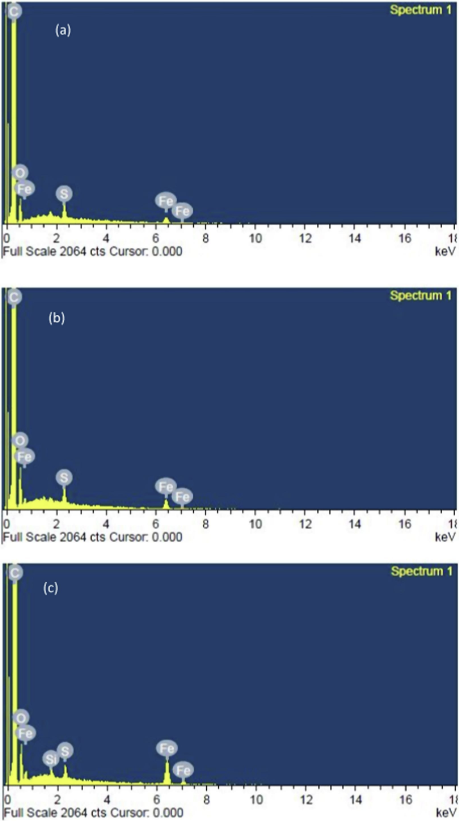
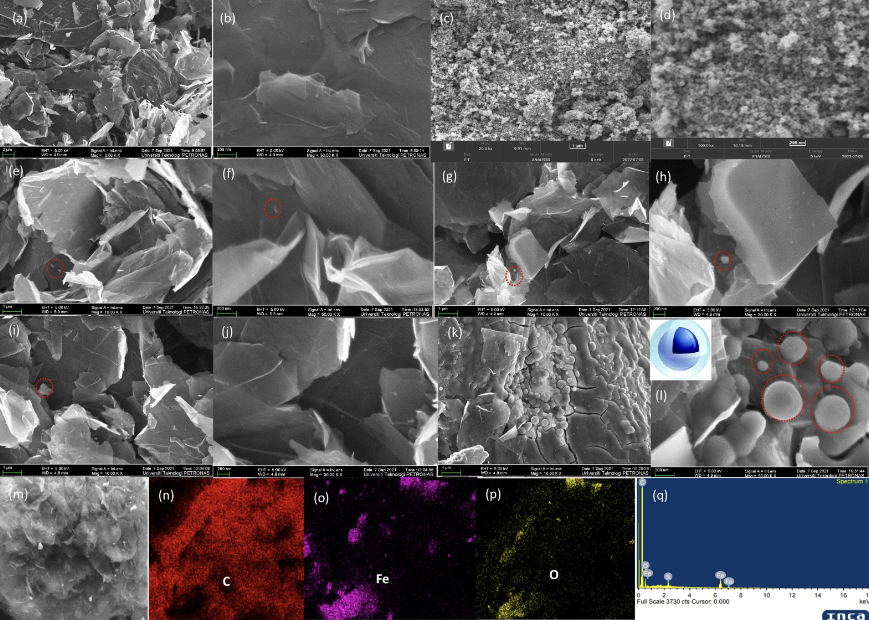
The surface morphology of the samples was analyzed using FESEM microscopy. Fig. 6(a) shows the FESEM of GNP. A two-dimensional platelet-like small stack of graphene with almost 15 nm thickness and 50-80 surface area was observed. Further magnification (Fig. 6(b)) revealed that GNP consists of a few layers which correspond to the wrinkled graphene layers. Fig. 6(c) and (d) show that the surface morphology of Fe3O4 has an irregular morphology with pores on the surface of the sample. The composite GG 1 (Fig. 6(e) and (f)) shows a platelet-like structure with a small spherical-like structure. The composite GG 2 (Fig. 6(g) and (h)) also shows the platelet-like structure of graphene and a spherical-like structure. For GG 4 sample (Fig. 6(i) and (j)), the FESEM image reveals the presence of a Spherical structure on the surface of the graphene nanoplatelets. For GG 3 sample (Fig. 6(k)), a core-shell image was observed across the surface of the graphene nanoplatelet layer [55]. Further magnification (Fig. 6(l)) reveals that the surface morphology of GG 3 has a crinkled and rough surface which is more visible at the interface between two particles. This could be ascribed to the presence of a protective, flexible, thin layer of GNP shell. Fig. 6(m) - (p) shows the electron image and elemental mapping of GG 3. Results show the homogenous distribution of C, Fe, and O across the surface of the sample. The Edx spectrum as shown in Fig. 6(q) shows the percentage of the element present in the sample.
Market Potential
Electronics and Sensors: Graphene's exceptional electrical properties make it ideal for use in transistors, sensors, and other electronic devices.
Energy Storage and Conversion:The global market for graphene-based batteries and supercapacitors is poised to grow as the demand for renewable energy storage solutions increases.
Biomedical Applications: The biomedical market for graphene and Fe3O4 composites is expanding with advancements in nanomedicine and targeted drug delivery systems.
Environmental Applications: They are utilized in water purification, air filtration, and environmental sensing due to their high surface area and adsorption capabilities.
Composite Materials:The market for advanced composites is expanding, driven by the need for materials that offer superior performance and durability.