Functional Near-Infrared Spectroscopy Adaptive Cognitive Training System (FACTS) for Cognitive Underload and Overload Prevention: A Feasibility Study
Author: Tang Toong Boon- September 2020
Wei Chun Ung, Fabrice Meriaudeau, Masashi Kiguchi
Abstract
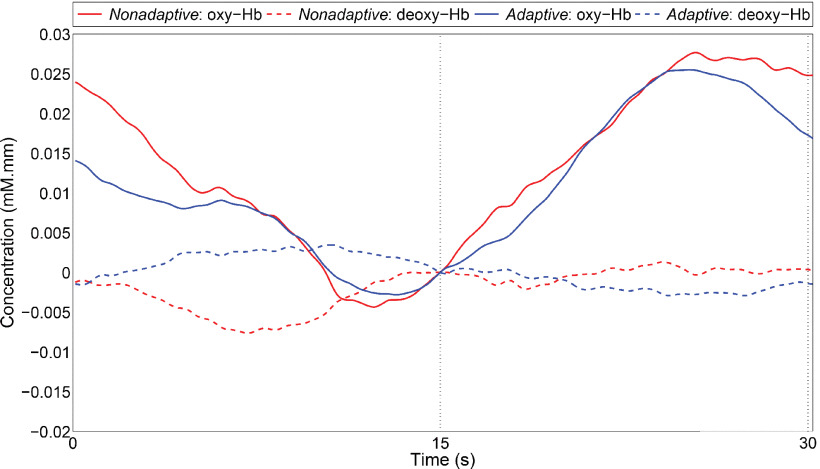
Mismatch between mental workload and working memory capacity can cause mental underload or overload. Adopting the Yerkes-Dodson law as the framework, functional near-infrared spectroscopy adaptive cognitive training system (FACTS) has been developed, whereby the mental workload shall never exceed an individual's capacity, to prevent those unintended conditions. It works by monitoring mental workload in real time and performing dynamic difficulty adjustment accordingly. The feasibility study involved thirty-seven healthy participants undergoing mental arithmetic task with and without FACTS. Without FACTS, the participants not only showed higher NASA Task Load Index scores but also poorer task performance and a significant drop in DLPFC activation towards the end of the task, signifying more severe mental overload. Conversely, they continued to exhibit manifestation of productive learning with FACTS despite showing early signs of mental overload. The study results demonstrated that it is feasible to implement the concept of FACTS. The actual gains from cognitive training will be investigated in future longitudinal study.
Methodology
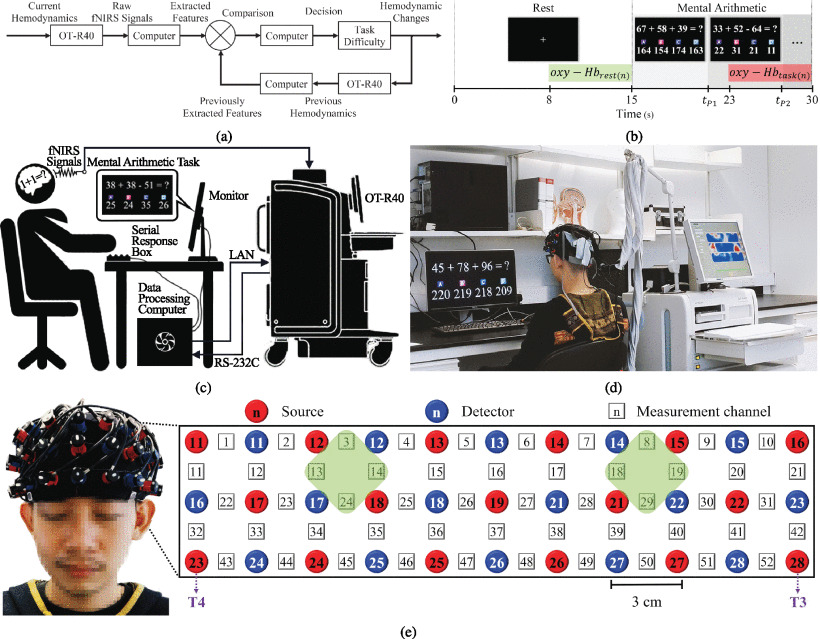
Mental arithmetic was used as the cognitive training task. After resting for 15 s, participants were asked to solve as many on-screen four-choice mathematical problems mentally as possible, at their own pace and within their capability, during the following 15-s task period. A 4-button Serial Response Box (Psychology Software Tools, Inc.) was also utilized to collect the participants' responses. Fig. 1b shows the paradigm for a single task trial. The mathematical problems only involved addition or subtraction or a mix of both. There were six levels of difficulty, each with a distinctive set of operands: 1) Two single digits; 2) Three single digits; 3) Two double digits; 4) Two single and one double digits; 5) One single and two double digits; and 6) Three double digits. The single-digit operands ranged from 1 to 9 while the three-digit operands lied between 10 and 99. All the operands and answers were non-negative. Besides that, there were no repeating number in all the mathematical problems. To avoid frustration at carelessness or failing to reach a solution, no answer feedback was presented.
Impact & Benefits
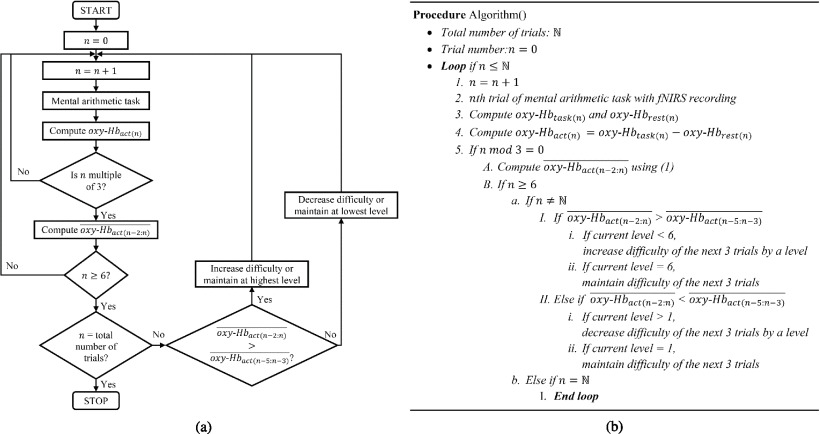
Improved Cognitive Performance: FACTS helps maintain an optimal level of cognitive engagement, preventing the negative effects of cognitive underload, such as decreased attention and performance. The system adapts the complexity and intensity of tasks based on real-time monitoring of brain activity, helping prevent cognitive overload, which can lead to stress and reduced efficiency.
Real-Time Adaptation: FACTS adjusts the difficulty of cognitive tasks in real-time using data from functional near-infrared spectroscopy (fNIRS). This ensures that individuals are neither under-challenged nor overwhelmed, promoting sustained engagement and effective training. The system provides immediate feedback on cognitive states, allowing users to recognize and adjust their cognitive efforts accordingly.
User-Friendly Interface: The study likely addresses the usability of the system, ensuring it is accessible and easy to use for individuals with varying levels of technical proficiency.
Cost-Effectiveness: By preventing cognitive overload and underload, FACTS can lead to more efficient use of time and resources in training and educational settings.
Market Potential
The market potential for the Functional Near-Infrared Spectroscopy Adaptive Cognitive Training System (FACTS) is substantial, given the growing emphasis on cognitive health, the expanding EdTech and digital health markets, and the need for innovative solutions in cognitive training. By leveraging real-time data to prevent cognitive underload and overload, FACTS addresses a critical need across multiple sectors, positioning itself for significant market adoption and growth.